Swanscombe
- Title
- Swanscombe
- Region
- Kent
- Country
- UK
- Description
-
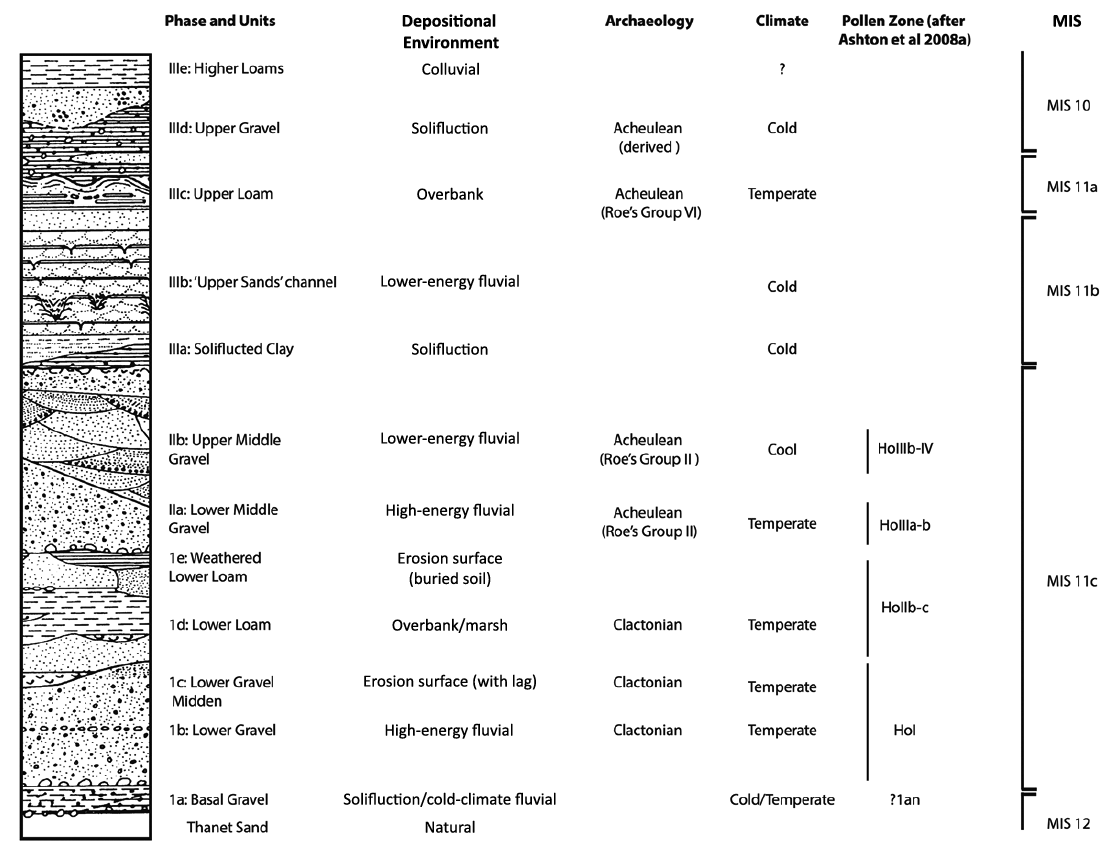
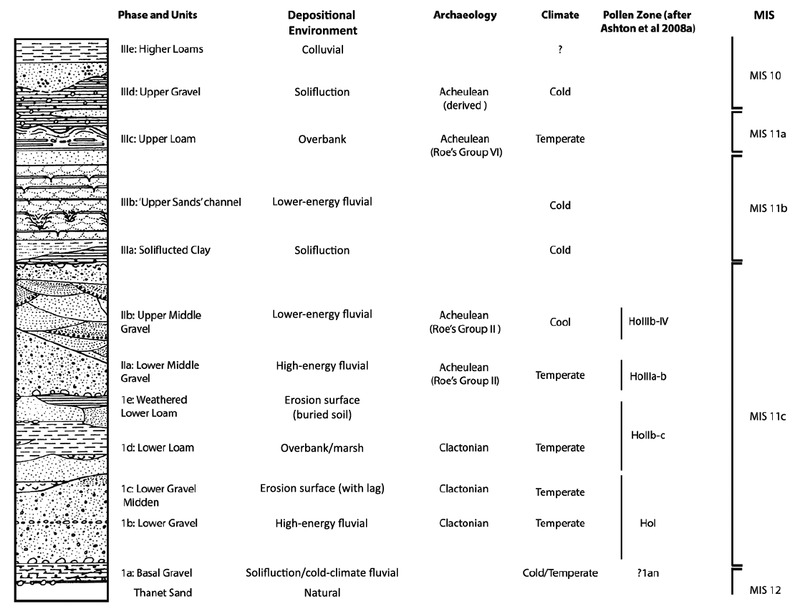
The famous deposits at Barnfield Pit, Swanscombe, have been studied on many occasions since their discovery in the 1880s (see Foulds et al. 2025). They lie on the Boyn Hill/Orsett Heath Terrace of the Thames and record a more-or-less complete sequence through terminal MIS 12, the whole of MIS 11 and the start of MIS 10 (Bridgland 1994). The most recent investigations by Conway (Conway et al. 1996) and Bridgland (1994) recognised three sedimentary divisions within the sequence, termed Phase I (Lower Gravel and Lower Loam), Phase II ( Middle Gravels, divided into upper and lower) and Phase III (Upper Sands, Upper Loams and Upper Gravel). The first two phases span terminal MIS 12 and the whole of MIS 11c, the latter attribution supported by altitude, the presence of a Rhenish molluscan fauna (which first appears in the Thames Valley in pollen zone HoIIIa), a typical MIS 11 mammalian suite and amino-acid racemisation (Bridgland 1994; Schreve 2001; Penkman et al. 2010; White et al. 2013). Archaeologically, these deposits contain the much-maligned Clactonian industry (in Phase I) and a point-dominated Acheulean assemblage attributed to Roe’s Group II, sub-group A (in Phase II).
Climatic deterioration begins at the top of Phase II deposits, as evidenced by the appearance of lemming and open-ground mollusca, with ice-wedge casts in the Upper Sands of Phase III also testifying to cold conditions. The overlying Upper Loams, interpreted as interglacial estuarine deposits, mark a return to warm conditions with higher sea levels (Hubbard in Conway et al. 1996). These loams contain an ovate handaxe assemblage assigned to Roe’s Group VI, with high frequencies of twisted edges and, in many cases, a white patina (Smith & Dewey 1913, 1914; White et al. 2019; Foulds et al. 2025). A mixture of all the Swanscombe assemblages is be found in the overlying Upper Gravels, a cryoturbated mass-movement deposit containing fossils of musk oxen and marking a return to extremely cold conditions. Conway (1996) suggested that the Upper Sands and Upper Loams belonged to MIS 10 and 9 respectively, although the presence of MIS 9 deposits on the lower Lynch Hill Corbets Tey terrace at Purfleet (Schreve et al. 2002; Bridgland et al. 2013) would suggest an MIS 11b and MIS 11a attribution, with the Upper Gravel marking the cooling limb of MIS 10.
-
- References
-
Bridgland, D.R. 1994. Quaternary of the Thames. London: Chapman and Hall.
-
Bridgland, D., Harding, P., Allen, P., Candy, I., Cherry, C., Horne, D., Keen, D., Penkman, K., Preece, R., Rhodes, E., Scaife, R. Schreve, D., Schwenninger, J.-L., Slipper, I., Ward, G., White, M., White, T. & Whittaker, J. 2013. An enhanced record of MIS9 environments, geochronology and geoarchaeology: data from construction of the High Speed 1 (London-Channel Tunnel) rail link and other recent investigations at Purfleet, Essex, UK. Proceedings of the Geologists’ Association 124: 417–476.
-
Conway, B., McNabb, J. & Ashton, N. (eds). 1996. Excavations at Barnfield Pit, Swanscombe, 1968–1972. London: British Museum.
-
Foulds, F., White, M., Rawlinson, A., Shipton, C. & Ashton, N., 2025. A twist in the tail: on the validity and characteristics of the Phase III handaxe assemblage from Barnfield Pit, Swanscombe, UK. Quaternary International 746: 109951.
-
Penkman, K.E., Preece, R.C., Bridgland, D.R., Keen, D.H., Meijer, T., Parfitt, S.A., White, T.S. & Collins, M.J. 2011. A chronological framework for the British Quaternary based on Bithynia opercula. Nature 476: 446–449.
-
Schreve, D.C. 2001. Mammalian evidence from Middle Pleistocene fluvial sequences for complex environmental change at the oxygen isotope substage level. Quaternary International 79: 65–74.
-
Schreve, D.C., Bridgland, D.R., Allen, P., Blackford, J.J., Gleed-Owen, C.P., Griffiths, H.I., Keen, D.H. & White, M.J. 2002. Sedimentology, palaeontology and archaeology of late Middle Pleistocene River Thames terrace deposits at Purfleet, Essex, UK. Quaternary Science Reviews 21: 1423–1464.
-
Smith, R.A. & Dewey, H. 1913. Stratification at Swanscombe: Report on Excavations made on behalf of the British Museum and H.M.Geological Survey. Archaeologia 64: 177-204.
-
Smith, R.A. & Dewey, H. 1914. The High Terrace of the Thames: Report on Excavations made on behalf of the British Museum and H.M.Geological Survey in 1913. Archaeologia 65: 187-212.
-
White, T.S., Preece, R.C. & Whittaker, J.E. 2013. Molluscan and ostracod successions from Dierden’s Pit, Swanscombe: insights into the fluvial history, sea-level record and human occupation of the Hoxnian Thames. Quaternary Science Reviews 70: 73–90.
-
White, M.J. Ashton, N.M. & Bridgland, D.R. 2019. Twisted handaxes in Middle Pleistocene Britain and their implications for regional-scale cultural variation and the deep history of Acheulean hominin groups. Proceedings of the Prehistoric Society 85: 61-81
- Raw material
- Flint